- MoneyBits
- Posts
- Making Tax Miserable

📚️ PDF⏳️ 6 min 📖 8
Making Tax Miserable
To great fanfare the UK Government is about to embark on its ‘Making Tax Digital’ program. The idea is to modernise tax collection and reporting by mandating that taxpayers keep digital records and submit returns on specifically approved software.
Large companies already do so but MTD makes this mandatory for every landlord, sole trader or self employed person in the UK. There was some helpful advice for them too on the HMRC website about how they could ‘connect their APIs’.
This guidance explains how you can integrate your software with our APIs. It provides examples of how they fit into various end-to-end user journeys to enable individuals and their agents, where authorised, to meet their obligations after they have signed up to Making Tax Digital (MTD).
Incidentally, ‘signing up’ to MTD is mandatory. So “are enlisted” would have been better.
It's rather more than finding software though and “connecting your APIs”. Taxpayers now need to submit five tax returns a year instead of one. Quarterly updates on your income and expenses, then a final tax return confirming you really meant what you have already told them. This is already required for VAT registrants which are an entirely different set of obligations. Again, large businesses do it already, but for everyone else (so 90% of businesses in the country) this is a new and as yet undiscovered nightmare.
Anyway, the net effect has been rather less than positive; here is Spectator columnist Lionel Shriver.
Most people will not be able to achieve this administration burden without professional help but there are nowhere near enough accountants to do this work in the UK. What’s more, if you do find help, at a minimum it will be £1,500 just for them to say hello and in the simplest cases you might get your five returns done by an accountant for £2,500.
The lower threshold of catchment here though is £50,000, which is clipped already by the government at 45%. They are suggesting now that everyone must contribute another 10% of their net income just to file a load of tax returns that HMRC doesn’t need and never previously required. What’s more it is not even intended to raise more money.
Now people are leaving, not really the country, but certainly the workforce. A slew of early retirements are incoming from contractors who simply cannot be bothered.
UK government expenditure is now 45% of GDP and rising, but really the number is false. It does not include the time spent by the private sector attending to government mandated admin which surely now exceeds 10% of all the time at work. In this case all the extra work will add nothing and probably less than nothing. One can only imagine the feast of money that consultants have had designing this nightmare and the software that goes with it.
Oil
Everyone was excited. “Oil is $120”.
The peak nominal price for oil was in 2008 when the price reached $147. Nothing much had happened other than a Goldman Sachs analyst, Arjun Murti, publishing his ‘super-spiker’ paper suggesting oil would reach $200 by 2010. He was, naturally, spectacularly mega-wrong. But nobody seemed to mind and he retired as a partner in 2014, sailing into the sunset on a yacht full of $40 oil.
Herewith then, oil priced in my beloved metric, dozens of eggs. Why eggs? Because the cost of production stays the same, we don’t get better (not that much anyway) at making eggs so the cost base stays consistent. It bounced around in covid and bird flu but ultimately hens lay eggs at the speed they lay eggs, you can't give them GPT and have it happen any quicker.
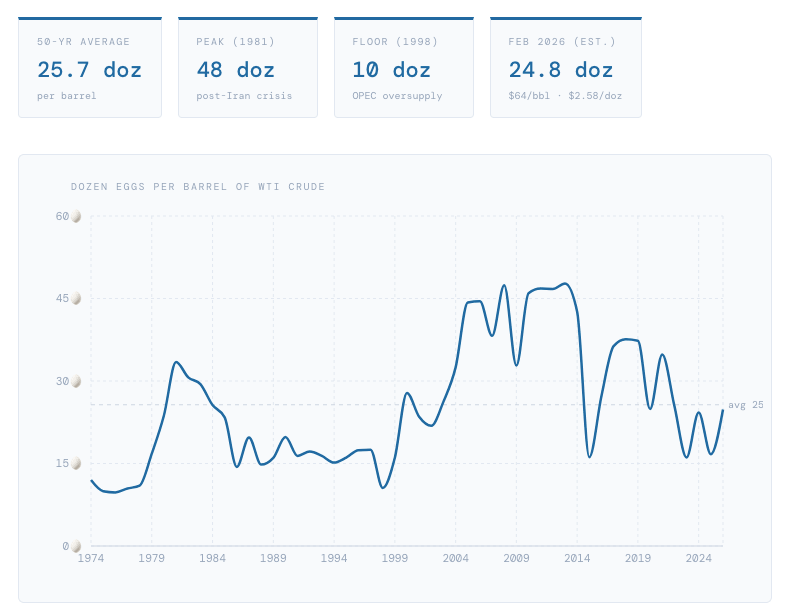
A barrel of oil today is about 25 dozen eggs, pretty much exactly on the long term average. The trend though, is downward. Since the super-spike of 2008 the oil price has consistently fallen as American production has ramped up. The USA now completely dominates world oil production, a fact that surprises most people. That fall in price was against a very stiff cost trend against fossil fuels, which itself is now reversing.
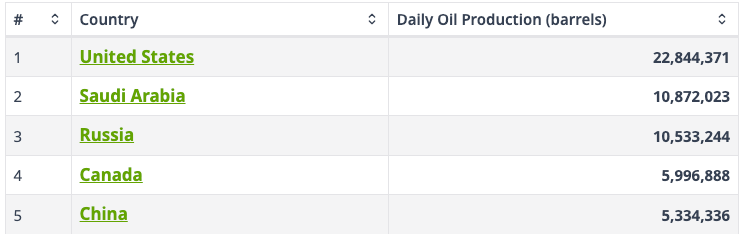
The only OPEC country in the top 5 is Saudi Arabia, making OPEC a footnote in oil history.
Then add Venezuela, much of their oil didn’t hit global markets. If America gets organised, production there could ramp up significantly. Iran itself represents only ~5% of global oil production so the disruption there is unlikely to have much effect but if things fell in a nice way (unlikely), then there might be slightly friendly Iranian oil hitting the global market in 2026. Small chance, but not no chance.
More broadly though, we are getting better at extracting oil all the time. The West is also waking up to energy demands and even countries like the UK will restart North Sea drilling and fracking, perhaps not in the next three years but certainly in the next ten.
Incidentally, if you were to say to people that you measure the performance of your investments in dozens of eggs you would be considered mad. People openly laugh at the suggestion as stupid. Yet it is a provably superior measure than nominal measurement.
That is the fiat currency story, a tremendous intellectual success. People think oil prices are near recorded highs, but it’s not even close. The deeply embedded measurement system that is so successful, so omnipresent, nobody cares to think about it.
The measurement basis explained

Not stable
During downturns you can broadly predict who will be influential when the mood finally shifts. Who is building when the chips are down? Which parts of the industry are looking several years ahead, longer.
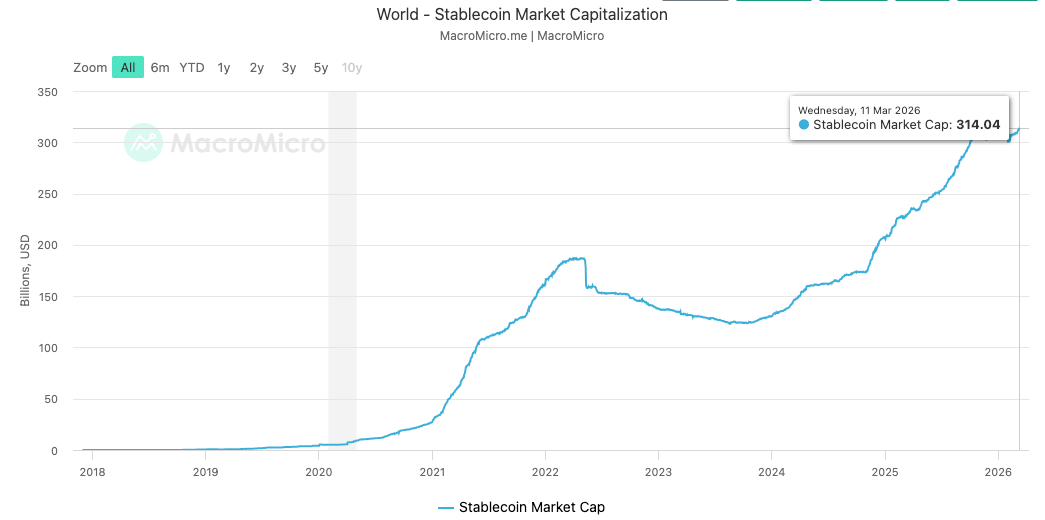
We are now at the all time high of stablecoin issuance. $314 billion. Perhaps more interestingly the once dominant Tether ($183bn) hasn’t moved much in months and all the growth is coming from the US based businesses most notably Circle, with its USDC.
And so what? Well the so what is simply that once money enters the crypto system it rarely leaves. The growth is real and people with USDC and USDt will trade bitcoin and other tokens but rarely do they go back to fiat. So it is meaningful for the future.
More than that the current growth is underpinned by a new regulatory environment in the US. Banks can custody these assets, you can borrow against them. The full suite of products that we enjoy in the fiat system is quietly being built out around a new set infrastructure. But again, so what? Well every stable coin is 100% backed (or more) by treasuries or equivalents. Every fiat coin is on average 7% backed by liquidity, the rest balances stand on the head of a needle. That needle being house prices, commercial property and commercial loans. Commercial bank balance sheets basically.
The default view is that the creditworthiness of a USD far exceeds that of USDC, where on closer examination I would argue the reverse is true. If the banking sky falls in, or house prices fall 50% I’d rather be in Tether than a commercial bank.
BlackRock even has a fund for USDC holders where they can invest with their stablecoin and earn income.
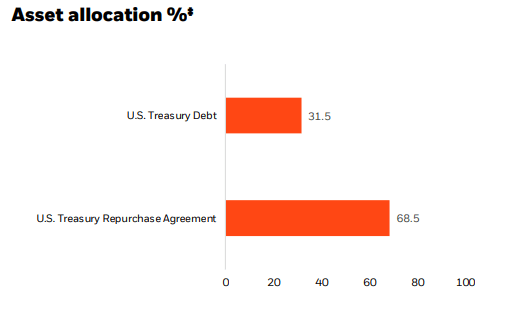
It’s not as though there is anything special about this fund either, it yields about 2.5%. It's simply that the acceptance of this technology is here. It is growing very quickly and very quietly.
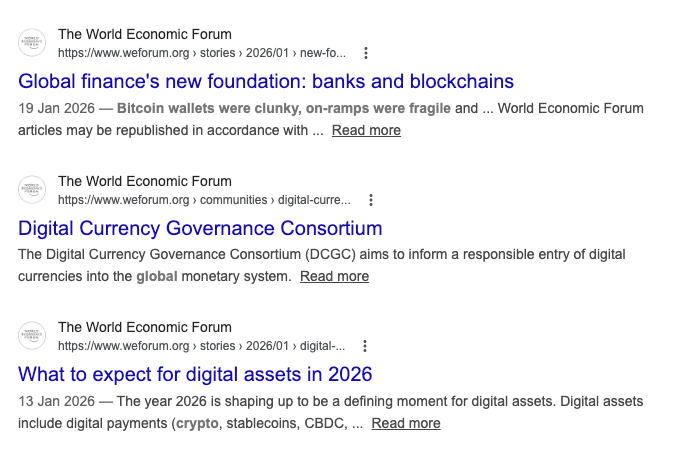
So much so that the World Economic Forum, who for so long hated this sector, published an article explaining what it is all about. Incidentally, their change of direction was rather obvious back in January when the gang were in Davos doing God’s work.
Euro-Trash
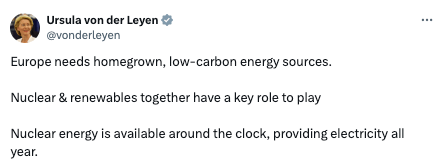
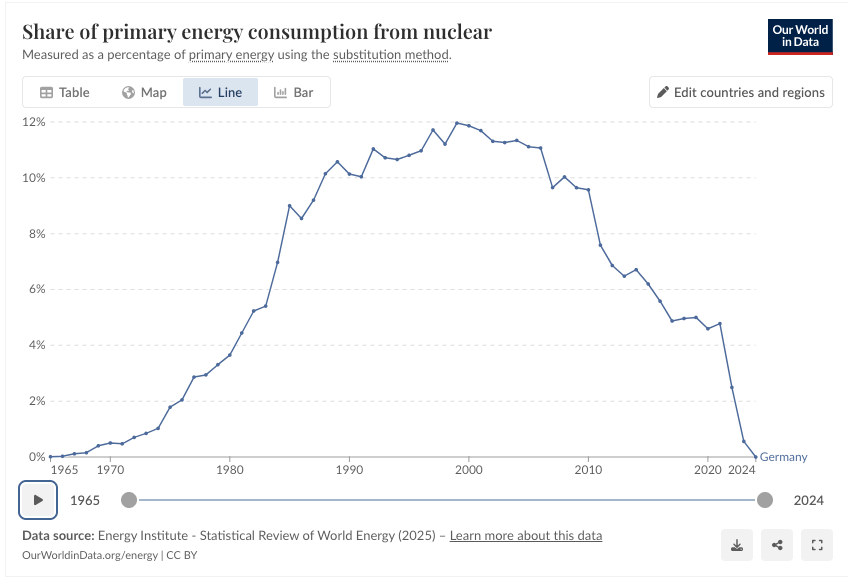
Nuclear? Surely not. Just years after Germany turned off the engine of its industrial base, Ursula is back telling us all how wonderful nuclear power is. It’s available around the clock!

A short tour of recent history will show her voting for the complete phase out of nuclear energy in the Bundestag archives. Yet now she is touring Europe spruiking the quality of Europe’s nuclear engineers, many of whom have lost their jobs as a result of her earlier vote.
In her speech this week: “we have far more nuclear engineers than the US and China”. China has 60 nuclear reactors and is building another 40. Maybe Europe has more engineers, but what are they actually building? The reality is they were fired over the last decade and have probably retired.
You would never get away with this in the private sector. A monumental, ideologically driven, wealth destroying, catastrophic decision. The nuclear chart maps almost directly to the success of the German economy. Absolutely industrially dominant at the turn of the century and for the decade that followed, then steep decline.
Further Information
Our February 2025 report to investors can be found here.